Hello!
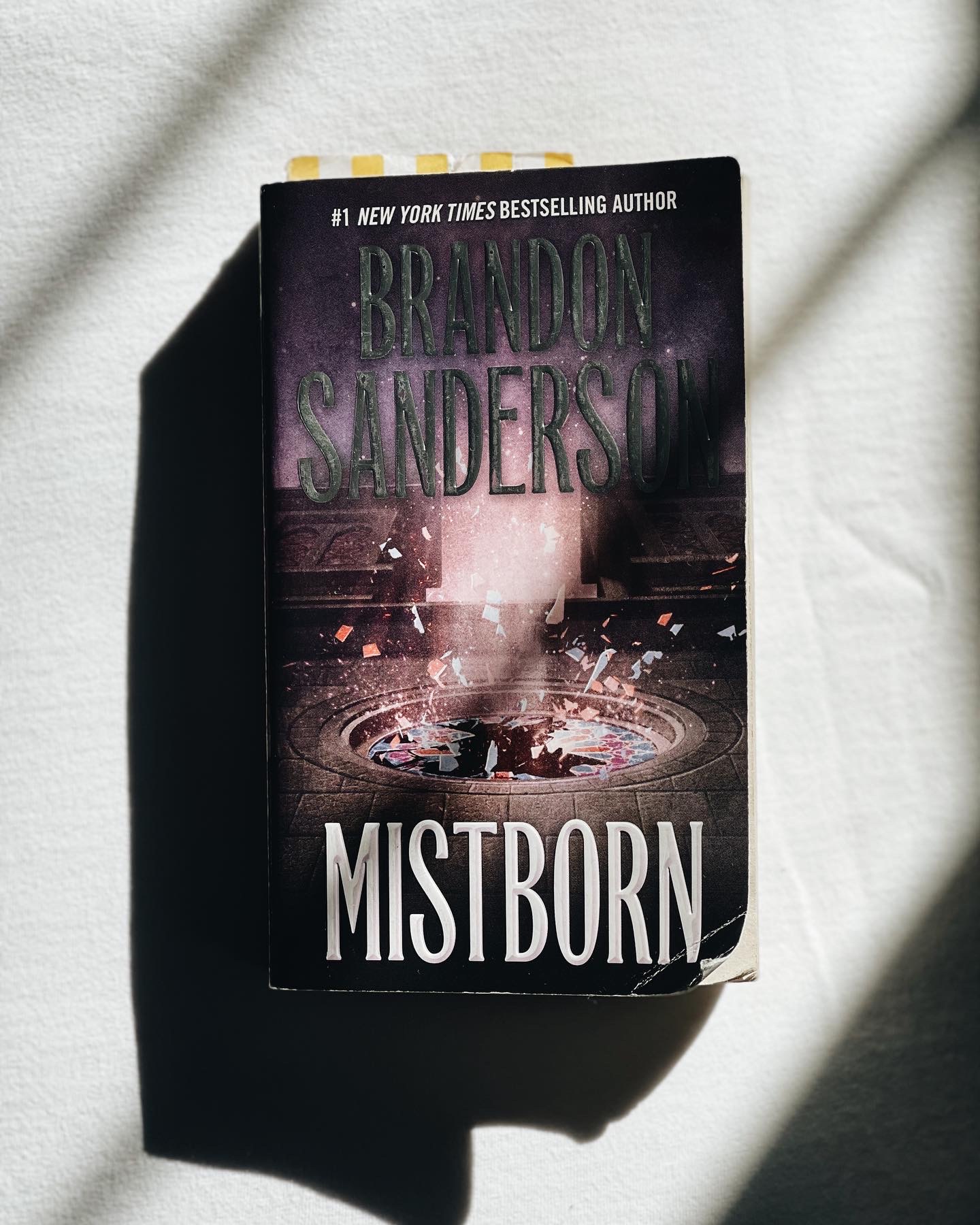
Last night, I finished my first book of 2022: Mistborn by Brandon Sanderson. Formerly known as Mistborn: The Final Empire, this book kicks off the Mistborn Trilogy– one of Sanderson’s most beloved adult fantasy series. The first half of this review will be spoiler free, and the rest will be all of my nitty-gritty thoughts on the events of the book. The two reviews will be the same, except the spoilers will be taken out of the non-spoiler one. If you’ve read the book, feel free to skip to the spoiler review.
I had a great time with this book, and am excited to share my thoughts!
The Premise
Mistborn takes place in the Final Empire, a nation that dominates the entirety of the known world. The immortal emperor, the Lord Ruler, has made the empire a place of despair– the peasant class, the skaa, have been beaten down and forced into submission for the past thousand years, while the nobility put them to work and subject them to abuses in the fields, mines, and forges. Ash falls from the sky, and nothing is green in the world.
Kelsier, a charismatic golden-retriever-energy skaa with a thirst for noble blood, and his ragtag gang of highly skilled thieves find themselves involved in a high-risk-high-reward job: stealing from the Lord Ruler himself.
Vin, a sixteen-year-old street urchin who’s been chewed up and spit out by Luthadel’s underground crime scene, doesn’t trust a soul in the world. While she’s incredibly suspicious of anyone who shows her kindness, Kelsier’s team makes her an offer that is hard to resist: a job, practical training in her newfound magical abilities, a bed to sleep in, and some colleagues who might not betray her immediately.
“Honestly, for an evil god of darkness, he certainly can be dull.”
– Vin, on the Lord Ruler’s writing style

The Magic System
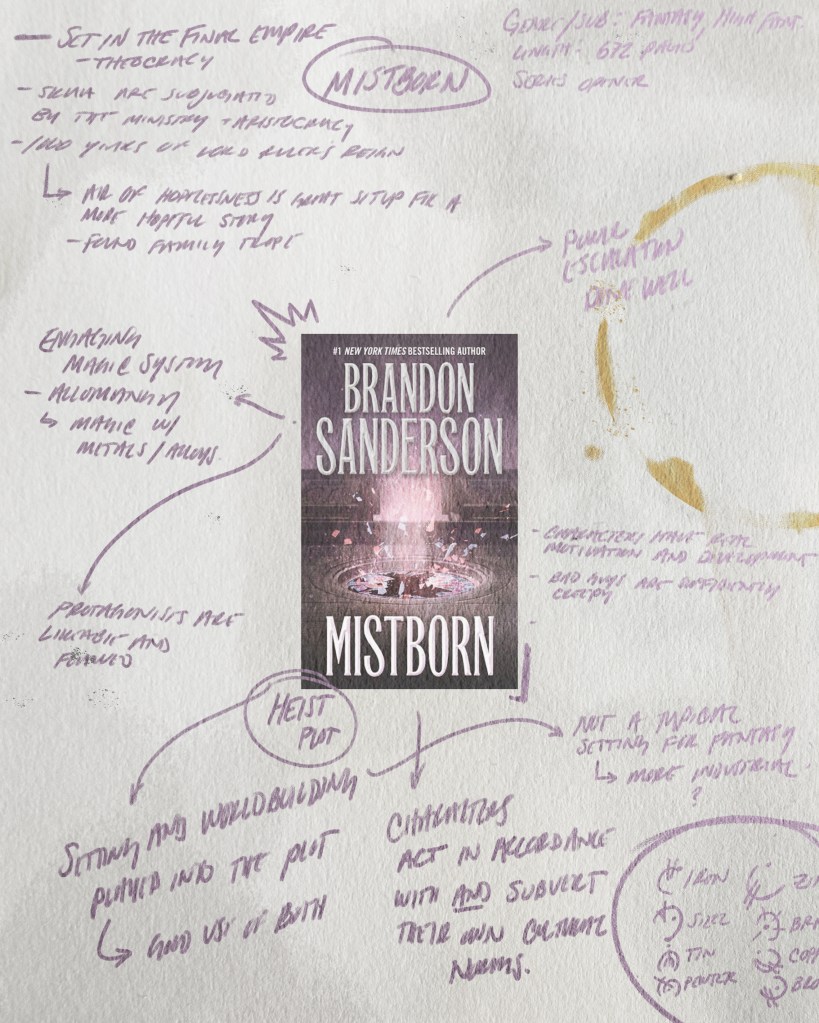
Allomancy is the primary magic system of Mistborn (there are others too– they’re really cool, but RAFO). Allomancers are able to ingest metals, and access different abilities based on which metal they “burn.” For example, tin enhances the senses: “Kelsier burned tin, feeling it flare to life in his chest, enhancing his senses. . . his ability to percieve simply increased.” Other metals have provide different abilities. Most allomancers, called Mistings, can only burn one metal. If one is able to burn all of the metals, they are called a Mistborn.
To name a few of the metals, pewter enhances physical strength and endurance, iron and steel allow the allomancer to push and pull on metal objects around them (making coins fly like projectiles, or pushing off of large metal objects to jump inhumanly high), and Brass allows the suppression of emotions (on oneself or others). The concept is relatively simple, but the applications of them are remarkably creative and dynamic– their uses and applications vary depending on the style of the allomancer and the task at hand, while always adhering to the physical laws allomancy is bound by.
“Every action we take has consequences, Vin. I’ve found that in both Allomancy and life, the person who can best judge the consequences of their actions will be the most successful.”
– Kelsier
For those unfamiliar, this is a great example of a hard magic system– it has a hard-and-fast set of rules, and the limitations and consequences of using the magic are defined to the reader somewhat clearly. The result is an engaging set of tools at that can be used to solve problems, and still feels satisfying to the readers. The typical cop-out solution of “a wizard waved his hand and fixed our problems” is virtually nonexistent in Sanderson’s magic. Progress towards the characters’ goals always feels earned.

Non-Spoiler Review!
Mistborn was a very fun read. Clocking in at 673 pages, this is a pretty short book by Brandon Sanderson’s standards and retains all of the action-packed high fantasty awesomeness we’ve come to expect from him.
The worldbuilding is perfect for what it is trying to accomplish– my first experience with Sanderson’s writing was the Stormlight Archive (Sanderson’s fantasy epic), so this world feels small and contained by comparison. That said, the smaller scale allows Sanderson to provide a greater deal of detail for every place he brings us to. It sucks me in, and I feel like I’ve lived in the Final Empire and Luthadel every time I open this book. Instead of having a “Farmy McFarmboy” character for us to discover the magical world through, we are given two unique protagonists; one who knows the magic inside and out, and one who’s ignorance of the magic is deliberate– it had been hidden from her for her entire life.
The melding of personality and culture in Mistborn is spot-on. Every time I read high fanstasy, I look for this. If the characters, their dispositions, beliefs, and prejudices don’t align with or react to the culture they grew up in, I am pulled right out of the story. From what I could tell on my first read, every character’s actions and motivations can be traced back to their culture, personality, past experiences, or any combination thereof. They are believable, realistic characters who are invested in the plot for meaningful reasons, making us as readers more invested in the plot. Not to mention, the protagonists are downright likeable and easy to root for (most of the time o_0).
“The right belief is like a good cloak, I think. If it fits you well, it keeps you warm and safe. The wrong fit however, can suffocate.”
– Sazed
Allomancy is a great example of how Sanderson ties magic in with his worldbuilding– the metallic basis of it allows him to engage the economy of the Final Empire intimately with magic and the regulation of it. Not to mention– it’s frickin’ cool. It makes for some fantastic high-flying action sequences and tense moments of intrigue and manipulation. It is a magic system that covers all the bases. There is one rule of the allomancy that seems like it’s only included to make the plot possible, but I’ll concede that issue because the plot is pretty great. I go into this more in the “spoilers” section.
Throughout the book, Sanderson does a great job acknowledging the moral dilemmas that arise in a way that allows him to pick his battles. There are plenty of situations where the ethics are ambiguous. Instead of letting the ambiguity hang, there are one or two characters who always brings up the sort of moral questions that matter to the audience. We come to expect that from them, as the other characters do, so it feels natural when they question the ethics of an action or situation. It clears the worry that Sanderson expects us to be chill with our protagonists doing sketchy immoral stuff, and reassures us that the characters have good reasons for doing what they do. Good move, Brando.
At no point in the story did I know how it was going to end. I’ve watched Sanderson’s BYU creative writing lectures, and he’s talked a good bit about plot and story structures. He’s mentioned a few times in those lectures that Mistborn is a great example of a heist story. Because of that, I expected it to be fairly straightforward and simple, more or less following the recipe for a good heist. While it seemed to start off like that, I was quite wrong in the best way– the story twists and turns in ways I didn’t predict. Sanderson does a great job writing twists such that you could predict them if you’re clever enough, but most people won’t be able to– a sign of a great writer. I won’t say more on that 😉
There are a couple of plot conveniences that bug me. To avoid spoilers, I’ll just say that it would have taken (ballpark) fifty dedicated pages to address one of them, so I don’t exactly blame Sanderson for leaving them in. I am a bit disappointed by them, but they didn’t detract from my enjoyment in the moment– though looking back, I wonder “what if they had been addressed?”
Lots of readers recommend Mistborn as a starting point for new Sanderson readers, and people getting started with high fantasy in general; I agree, though I’m still of the opinion that Warbreaker is a better starting point based on the fact that it is a standalone. I go back and forth between whether I’m a bigger fan of Allomancy or BioChroma– long story short, I think they’d both make great starting points, and I could argue either side. I’d say I lean towards recommending Warbreaker– I think it has more elements of what beginners expect from fantasy (a lively, bustling city with taverns and palaces), where Mistborn is different enough from typical fantasy aesthetics that it may not hook beginners as much. Just conjecture. Both wonderful books with engaging plots and great characters!
I’m very glad to have started 2022 off with Mistborn! I enjoyed reading it from start to finish, and I am excited to read the Well of Ascension and Hero of Ages. Given how well the first book wrapped up the main plot, I’m curious where the next will pick up– there are enough options that it is hard for me to predict right away. Regardless, I’m looking forward to it!
Spoilers!
Mistborn was a very fun read. Clocking in at 673 pages, this is a pretty short book by Brandon Sanderson’s standards and retains all of the action-packed high fantasty awesomeness we’ve come to expect from him.
The worldbuilding is perfect for what it is trying to accomplish– my first experience with Sanderson’s writing was the Stormlight Archive, so Scadrial feels small and contained by comparison. That said, the smaller scale allows Sanderson to provide a greater deal of detail for every place he brings us to. It sucks me in, and I feel like I’ve lived in the Final Empire and Luthadel every time I open this book. Instead of having a “Farmy McFarmboy” character for us to discover the magical world through. we are given two discinctive protagonists; one who knows the magic inside and out, and one who has had the magic deliberately hidden from her and her social class for her entire life– it is not a coincidence that Vin is uninformed. Allomancy is something that the Lord Ruler and aristoctacy have determined she should not know about.
The melding of personality and culture in Mistborn is spot-on. Every time I read high fanstasy, I look for this. If the characters, their dispositions, beliefs, and prejudices don’t align with or react to the culture they grew up in I’m pulled right out of the story. From Vin’s unlearning of her thieving ways to better blend in with the court to Kelsiers outright hatred for the nobility, the characters posess the perfect blend of individual personality/experiences and the worldbuilding. Sazed is a shining example of this — he is conditioned to be a subservient steward, and is. There are times when this guides his actions, like his discussion of servitude with Vin in chapter sixteen. He says, “‘We are eager to do as we are told, quick to seek subjugation. Even I, whom you dub a rebel, immediately sought out a position of stewardship and subservience.'” Even with his acknowledgement of this strong urge to serve, there are times that his individuality guides his decisions– He is a Keeper, so his existence is an act of treachery against the Lord Ruler in and of itself. His willingness and ability to subvert his conditioning is owed in large part to this other immense duty he has– preserving pre-empire knowledge. This is the only known factor that encourages him to rebel to a greater extent than his fellow Terrismen, and makes room for his personality to shine through. Sazed is a fairly bold example of this melding of character and worldbuilding. From what I could tell on my first read, every character’s actions and motivations could be traced back to their culture, personality, past experiences, or any combination thereof. In less convoluted terms, they are believable, realistic characters that were invested in the plot for meaningful reasons.
Allomancy is a great example of how Sanderson ties magic in with his worldbuilding– the metallic basis of it allows him to engage the economy of the Final Empire intimately with magic and the regulation of it. Not to mention– it’s frickin’ cool. It makes for some fantastic high-flying action sequences and tense moments of intrigue and manipulation. It is a magic system that covers all the bases. My only probem with it is that some of its rules seem too convenient– like the fact that metal that pierces a human body, or is otherwise internal, can’t be Pushed or Pulled (unless the allomancer is ridiculously powerful). Most of it beyond that seems to be based in the metals’ physical properties; there must be something physical about pewter that makes it enhance strength, and so on. The piercing rule, however, seems to exist only to serve the plot– allomancy is pretty useless if anyone can Pull the metals out of a character’s stomach, or if any old Coinshot could Push the spikes out of an Inquisitor. It was a good move to include that rule, since it makes everything else possible. It feels odd to be discussing how “realistic” a magic system feels, but that one rule is the only part of allomancy with no implied reason behind it. Regardless, I think Allomancy is a great magic system.
Throughout the book, Sanderson does a great job acknowledging the moral dilemmas that arise in a way that allows him to pick his battles. An early example is the debate between Ham and Breeze about whether Soothing is a morally justafiable ability. Ham says that use of Soothing is a violation of the victim’s free will– the user is unable to consent to the alterations of their mood, and is forcibly made more likely to succumb to the manipulation that follows. Breeze asserts that Soothing is merely another form of encouragement comparable to the wide variety of manipulative tactics people use all the time– maybe manipultation isn’t morally justifiable itself, but Soothing is no better or worse than the garden variety. Any reader could reasonably side with either character, and Sanderson doesn’t need to provide a solid answer to us– all he had to do to satisfy is bring up the argument, and acknowledge that the ethics could go either way. Having Ham as a character who always brings up those sorts of moral questions was a good choice. We come to expect it from him, as the other characters do, so it feels natural when he questions the ethics of an action or situation. They act as a stand in for the reader who is uncomfortable with the actions of a protagonist (as I was a few times). It clears the worry that Sanderson expects us to be chill with immoral heroes, and reassures us that the characters have good reasons for doing what they do. Good move, Brando.
Let’s discuss the ending. At no point in the story did I know how it was going to end. I’ve watched Sanderson’s BYU creative writing lectures, and he’s talked a good bit about plot and story structures. He’s mentioned a few times in those lectures that Mistborn is a great example of a heist story. Because of that, I expected it to be fairly straightforward and simple. I was quite wrong in the best way– the story twists and turns in ways I didn’t predict. Sanderson does a great job writing twists such that you could predict them if you’re clever enough, but most people won’t be able to. I liked it– it wrapped up all of the plot points we care most about, while leaving plenty of possible loose ends for book two to pick up on. It could have been a standalone, and the ending still would have made perfect sense.
I found it mostly satisfying, but I don’t think it hit me as hard as other readers said it might. Specifically, I’m not sure how I feel about Marsh’s role at the end. I think that it was absolutely incredible to see him come back as an inquisitor to fight the Lord Ruler– the moment that Vin realized it was him was stunning. That said, I would have loved to see Marsh’s perspective enter the narrative after Kelsier believed he was dead. I could go into heavy detail. . . and I will.
If Sanderson had shown us that Marsh was alive and infiltrating the Canton of Inquisition shortly after Kelsier believed him to be dead, we would have gained a boatload of dramatic irony. Think about Kelsier recklessly throwing himself into a deathmatch with an Inquisitor thinking it killed Marsh, while we know that Marsh is alive and well. Think of Kelsier being struck down by the Lord Ruler thinking everyone he loved had died, while we see Marsh figuring out the weakness of the Inquisitors behind the scenes. In the moment that Vin belives she is doomed to die in Kredik Shaw by the Lord Ruler’s hand, Marsh joins the fray. We see Vin’s fantastic realization, but the difference is that we got to see Marsh’s struggle to get there in time– after all, he was busy ripping spikes out of the Inquisitors’ backs. The pile of bloody stakes on the floor would feel much more earned. As it stands, that plot point relies on logic something like “turns out it was just a miscummunication! Marsh is alive, and he managed to kill every single Inquisitor in Luthadel ‘off camera’ between the scene where the lord prelan is killed and the fight with the Lord Ruler.” In the moment I was reading it, I loved that scene, but looking back I’m not the biggest fan. I would have gladly read fifty more pages to accommodate a Marsh POV.
Lots of readers recommend Mistborn as a starting point for new Sanderson readers, and people getting started with high fantasy in general; I agree, though I’m still of the opinion that Warbreaker is a better starting point based on the fact that it is a standalone. I go back and forth between whether I’m a bigger fan of Allomancy or BioChroma– long story short, I think they’d both make great starting points, and I could argue either side, but I’d say I lean towards recommending Warbreaker. I think it has more elements of what beginners expect from fantasy (a lively, bustling city with taverns and palaces), where Mistborn is different enough from typical fantasy aesthetics that it may not hook beginners as much. Just conjecture. Both wonderful books with engaging plots and great characters!
I’m very glad to have started 2022 off with Mistborn! I enjoyed reading it from start to finish, and I am excited to read the Well of Ascension and Hero of Ages. Given how well the first book wrapped up the main plot, I’m curious where the next will pick up– there are enough options that it is hard for me to predict right away. Regardless, I’m looking forward to it!
 Sam D. Cote
Hello sam
Very well written review although I would like to mention those issues with the metal not being ripped away from the stomach I would say keep on reading the books 😉
LikeLike
Good to know thank you! I’ll keep that in mind 😁
LikeLike