Hello!
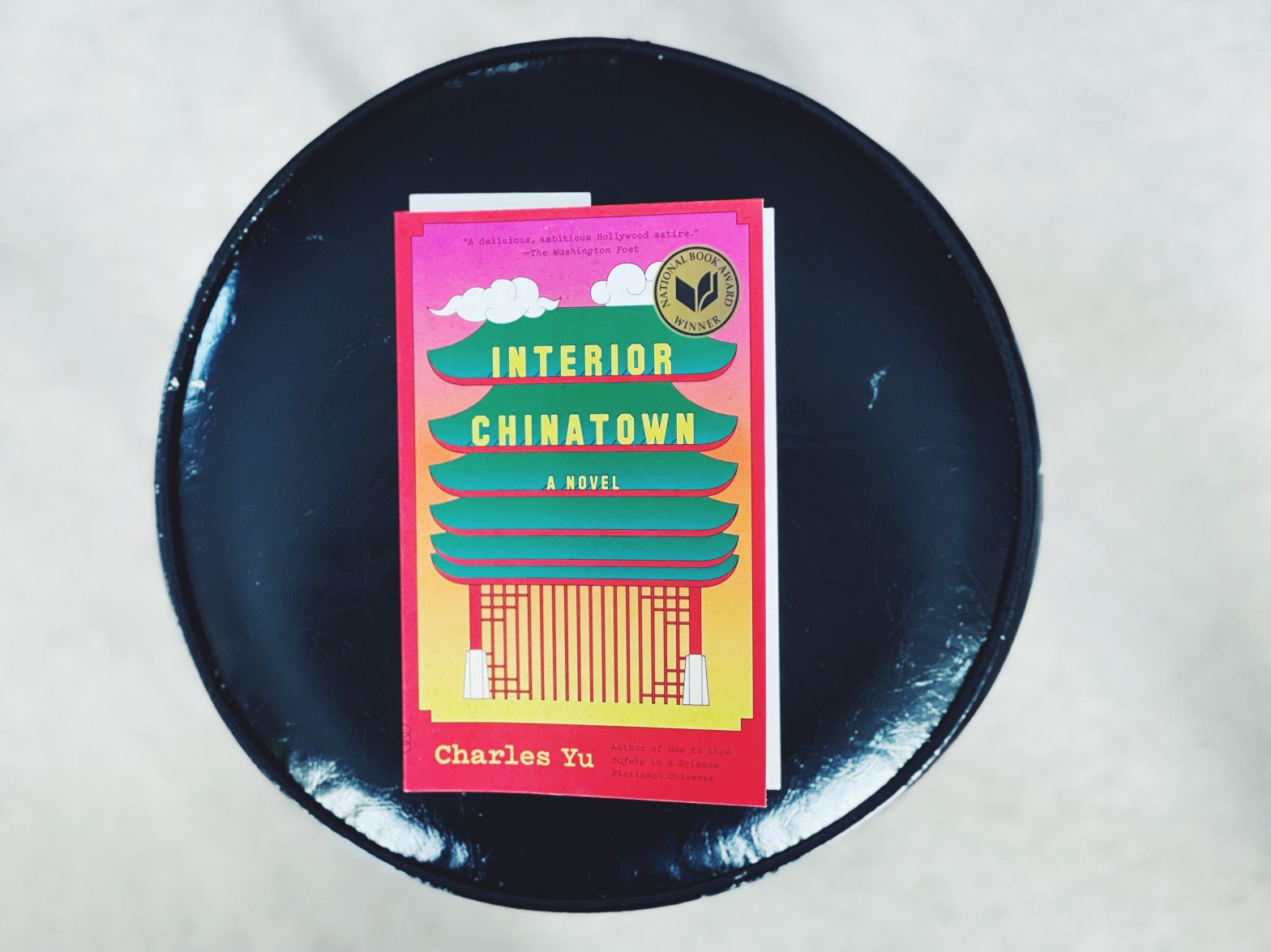
I recently finished reading Interior Chinatown by Charles Yu. This novel is deeply thought provoking, reflective, and challenging while maintaining moments of joy, hope, humor and inspiration.
This book could not be more different from my previous read, Mistborn. As such, the review is formatted differently– for instance, there’s no magic system to talk about, or worldbuilding to analyze. This review is shorter as a result, and I don’t feel the need to get into spoilers– it’s a relatively short book, and most of it can be talked about openly without spoiling the plot. Thanks for bearing with me as I work towards finding a review style that works for me!
Review
Interior Chinatown takes place in– you guessed it– Chinatown! The specific American city this Chinatown is in remains ambiguous, which I think serves thematic purposes.
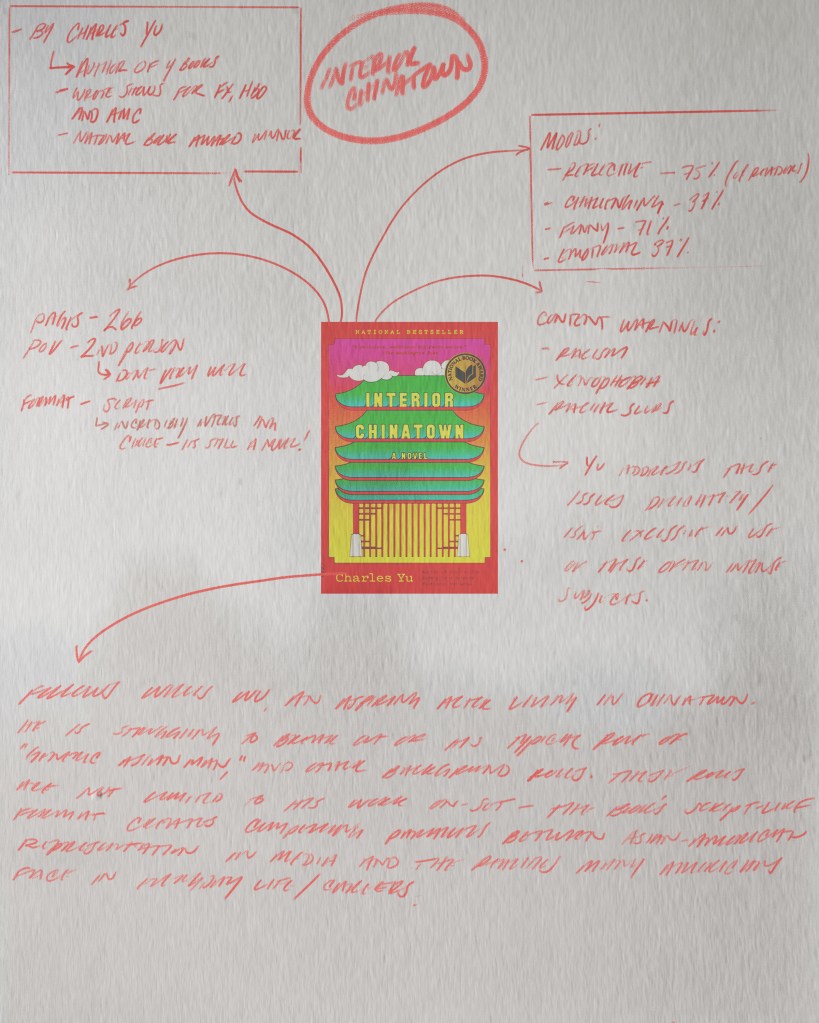
This book can’t be discussed without acknowledging the incredible format decisions made by the author: it is a novel, yet it is formatted more like a television script, with some scenes taking place inside a fictional TV show. It is all written in second-person point of view (POV), which is a very interesting (and effective) choice. The story follows Willis Wu, an aspiring actor who grew up in Chinatown– this is the character referred to as “you” throughout the story. The TV script format follows Willis both on and off set, infusing his life with theatrical metaphors– it speaks to the roles each person plays in society, the roles that a “Generic Asian Man” must play in order to find success in society, and how that all relates to the aspirations of (and possibilities for) Asian-Americans in Chinatown (and American society at large). I’ve never seen the format of a book serve the story’s themes so directly and effectively.
“Ever since you were a boy, you dreamt of being Kung Fu Guy. You are not Kung Fu Guy. You are currently Background Oriental Male, but you’ve been practicing. Maybe tomorrow will be the day.”
Charels Yu, Interior Chinatown
The second-person POV sounds like it would be jarring, but it actually took me a few chapters to realize it was second-person at all. I think this has less to do with my comprehension abilities, and more to do with Yu’s incredible control over his writing. The way he writes feels very natural, and the second-person POV is really effective for situating oneself within the narrative– it’s easy to get sucked into the beautifully detailed settings Yu lays out, even when the settings are not conventionally beautiful. The POV helps us build empathy for Willis, his family, and his community, and Yu is able to show us the world through Willis’ eyes. At times, it reads more like a memoir than a fictional novel.
“Black and White always look good. A lot of it has to do with the lighting, designed to hit their faces just right. Someday you want the light to hit your face like that. To look like the hero. Or for a moment to actually be the hero”
Charles Yu, Interior Chinatown
While there were a few times when I laughed out loud while reading, there are some parts of this book that are quite heavy and serious. It is eye-opening in its explorations of media and Asian-Americans in television and film, and sheds light on some of the challenges that many Americans face daily– discrimination, hate crimes, misrepresentation/flanderization in media, among other things (listed below). I read this at the same time as Mistborn to give myself a bit of respite from the intense scenes that occasionally arise in Interior Chinatown. As I mentioned, it is very well-written, emotionally compelling, and direct in its social commenttary– if you choose to pick this up, I recommend reading it at a comfortable pace and having a lighthearted book on the side to pick up after reading particularly intense chapters. This has been a great strategy for me, and made it easier for me to get through many serious-toned books. With that said, here are some content warnings for Interior Chinatown:
- Racism – from systemic to interpersonal, this book has depictions of various kinds of racism against Asian-Americans.
- Racial slurs and hate crimes – there are a few scenes where characters discuss racial slurs they’ve been called, and descriptions of violent hate crimes committed against a few of the characters.
- Xenophobia – Goes hand-in hand with the last bullet, and commentary on Xenophobia in media-related settings.
- Sexual Assault – I believe there is only one scene where S.A. is at the forefront- worth mentioning in this list.
Interior Chinatown won the National Book Award, and I can certainly see why– It is brilliant in many regards. It is fast-paced, while maintaining intentionality and conciseness. I laughed, and I cried. It’s full of hope, pain, joy, and sorrow– it is truly remarkable what Yu has managed to achieve in just 265 pages.
Thank you for reading!
I’ll have more book reviews coming soon! I’m heading out for study abroad in Prague very soon, so I’m unsure of what my reading schedule will look like– I’ll definitely have reviews for the next few weeks. I’m particularly excited to share my thoughts on the next one, The Cat Who Saved Books by Sosuke Natsukawa. Subscribe to the email list, and never miss the weekly post! Take care.
 Sam D. Cote